
Settings
TODO
The Settings (also called Options) allow you to configure various behavioral aspects and features of the application. You can access them via the Options main menu item, the Settings button in the toolbar, or by using the F4 shortcut key.
The available settings are split into several broad categories outlined below.
General
This section control the general behavour of the application, including automatic startup, saving and loading of user configuration, and the visual behaviour of the main window.
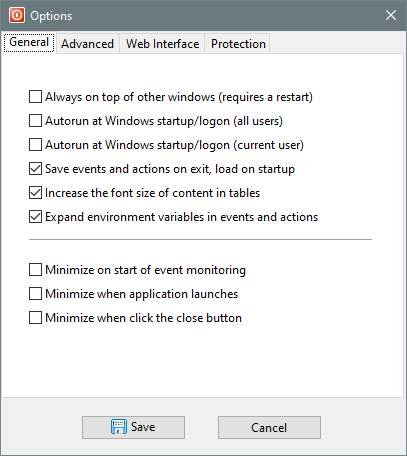
- Always on top of other windows
(requires— Keeps Shutter on top of the other windows on the desktop. Requires arestart)restart of the application. - Autorun at Windows startup/logon
(— Starts Shutter automatically when you log in to Windows. This option can be applied to allusers)users or just the current user. In order to apply this option to all users, you must launch Shutter as an Administrator just to apply option successfully. Autorun at Windows startup/login (current user)
Advanced
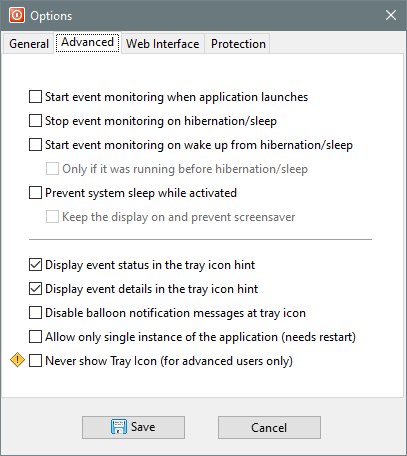
- Start event monitoring when application launches
- Stop event monitoring on hibernation/sleep
- Start event monitoring on wake up from hibernation/sleep
- Only if it was running before hibernation/sleep
- Prevent system sleep while activated
- Keep the display on and prevent screensaver
- Display event status in the tray icon hint
- Display event details in the tray icon hint
- Disable balloon notification messages at tray icon
- Allow only single instance of the application (needs restart)
- Never show tray icon (for advanced users only)
Web Interface
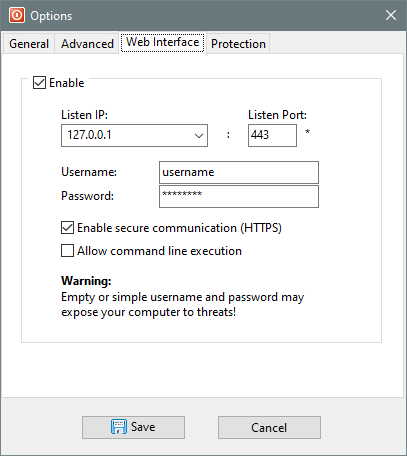
- Enable
- Listen IP
- Listen Port
- Username
- Password
- Enable secure communication (HTTPS)
- Allow command line execution
The Web Interface allows you to control Shutter and your computer remotely, inlcluding starting event monitoring, executing actions, and even executing arbitrary commands. This is covered in depth in a separate article.
Protection
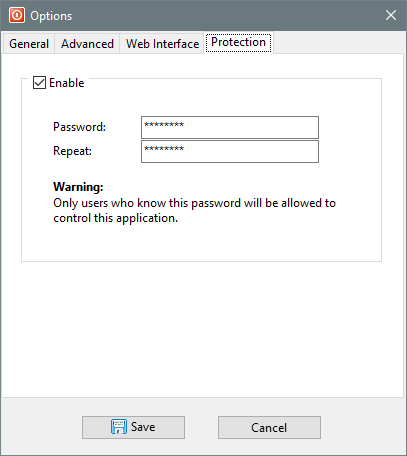
- Enable
- Password
- Repeat