
Pascal Script rule
This rule allows you define your own renaming logic and integrate external tools. It uses the the Pascal Script programming engine with syntax and conventions similar to Delphi/Pascal language. The rule comes with a number of preloaded example scripts. We will see how to use them, and how to write your own script.
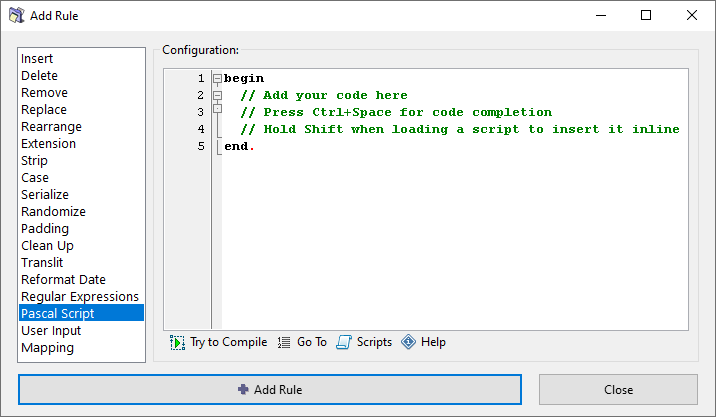
Writing your own script
To write your own script, you need to have knowledge of Pascal Script syntax and conventions, and be familiar with the list of built-in types and functions. All that you can learn using a dedicated Pascal Script reference section.
Let's assume that you already know how to write scripts.
The general workflow is as follows:
- Write your script, or load one from an external source.
- Compile the script by pressing the Try to Compile button.
- If an error message comes up, troubleshoot the script. The error message usually includes the line number of the problematic statement in the script. Press the Go To button and enter that line number to locate the faulty statement quickly. Once you correct the fault, press the Try to Compile button again. Repeat until you see a Compiled successfully! message.
- Add the rule to your renaming stack by clicking the Add Rule button.
- Optionally, you can save the script to the built-in repository via the Scripts menu, for quick access and reuse later.
The editor provides basic syntax highlighting and auto-completion for built-in functions, via the CTRL+Space shortcut.
To get you started, let's try this example script, which will simply prefix each filename with "Example" text:
begin
  FileName := 'Example ' + FileName;
end.
Loading a script
You can access your local scripts repository via the the the Scripts menu. The menu will show you a list of preloaded example scripts and any scripts which you have saved previously. Click on any of the script names in the menu to load it into the editor.
You can assemble your script using multiple scripts by holding down the SHIFT key when loading a script, which will insert it inline instead of replacing the whole script, just make sure to combine them correctly.
In addition to the preloaded example scripts, you can find more examples and user contributed scripts at:
- Examples repository for simple how-to examples.
- Library repository for advanced examples and 3rd party tool integrations.
- User Forum for user contributions.