
Main settings
This page describes the settings that control ReNamer's behaviour in various ways.
General settings
These settings control the general behaviour of the application.
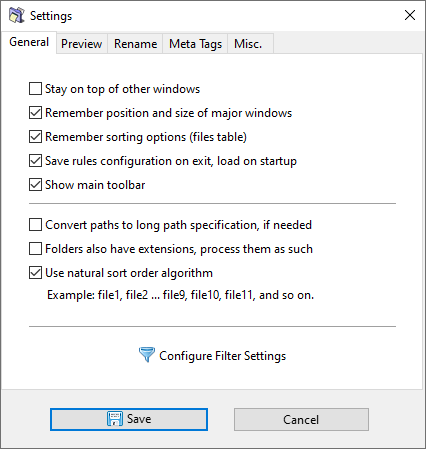
| Option | Description |
|---|---|
| Stay on top of other windows | Keep the ReNamer window on top of other applications. This is useful when adding files via drag-and-drop from Windows Explorer, as the ReNamer window will not disappear behind the Explorer window while you work. |
| Remember position and size of major windows | Retain the size and position of major windows between sessions, so they do not need to be repositioned each time ReNamer starts. |
| Remember sorting options (files table) | Retain the file sorting order between sessions. |
| Save rules configuration on exit, load on start up | Remember the currently loaded rules or preset on exit and restore it automatically on the next start. As of v7.2.0.6 Beta, the default preset is remembered by preset name rather than as an anonymous default preset, unless the preset was in a modified state at the time of saving. |
| Show main toolbar | Show the main toolbar. When disabled, the toolbar is hidden to gain extra space for the rules and files tables. All actions normally available in the toolbar remain accessible via the main menu or keyboard shortcuts. |
| Theme | Choose the application appearance between Light and Dark modes. The Auto option will use the Dark mode if the system prefers dark mode. Requires a restart of the application for the change to take effect. Supported on Windows 10 and later. |
| Convert paths to long path specification, if needed | Convert all added paths to long path specification when the system does not support long paths natively. This prefixes paths with \\?\, raising the maximum path length enforced by Windows from 260 characters to 32,767 characters.Added in v7.8.0.2 Beta. |
| Folders also have extensions, process them as such | A file extension is defined as whatever follows the last dot in the filename. This setting controls whether the same concept applies to folders, i.e. whether folders can have an extension. Prior to v5.74.5 Beta, a dot in a folder name was also treated as identifying an extension, so the Skip Extension option in rules applied to folders as well. In newer versions this is no longer the case, but this setting restores the old behaviour. |
| Use natural sort order algorithm | When enabled, filenames are sorted in Natural order; otherwise they are sorted in Lexicographical order. See the sorting algorithms section below for details. |
Sorting algorithms
Two sorting algorithms are available for ordering files in the files table.
Natural
Numbers embedded in filenames are sorted by their numeric value rather than character by character, which produces a more intuitive ordering:
Name1.ext
Name2.ext
Name3.ext
Name10.ext
Name20.ext
Lexicographical
Filenames are sorted as in a dictionary, strictly by character position from left to right. This means numeric portions are sorted by digit, not by value:
Name1.ext
Name10.ext
Name2.ext
Name20.ext
Name3.ext
Preview settings
These settings apply to the preview operation.
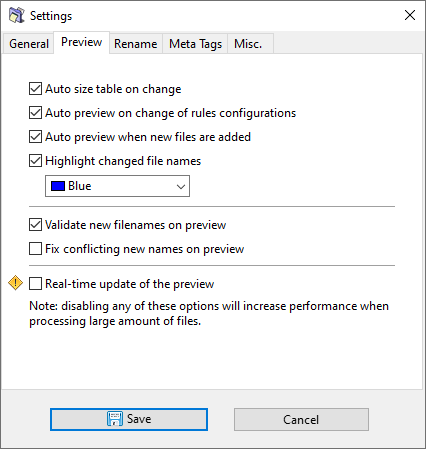
| Option | Description |
|---|---|
| Autosize table on change | Automatically resize each column to fit the longest name it contains. |
| Auto preview on change of rules configurations | Refresh the preview automatically whenever a rule is added, removed, or edited. |
| Auto preview when new files are added | Refresh the preview automatically whenever a file is added to the files table. |
| Highlight changed file names | Highlight new names in a specified colour when they differ from the original names, making it easy to see which files are affected by the active rules. |
| Validate new filenames on preview | Raise a warning if any new filenames are not valid. See Validation for details on what is checked. |
| Fix conflicting new names on preview | Resolve new name conflicts automatically by appending a numeric suffix, producing names such as Name (2), Name (3), and so on. This can also be triggered on demand via the Options menu. |
| Real-time update of the preview | When disabled (the default), clicking Preview shows no progress until all files have been processed. When enabled, files are updated one by one to provide live visual feedback. Warning: ReNamer continues to accept mouse and keyboard input while processing in order to keep the interface responsive. Any interaction with the UI during processing may lead to unpredictable behaviour. Use this option with extreme caution, and only when heavy per-file processing is involved, such as hash or checksum calculations or other content analysis. |
Rename settings
These settings apply to the renaming process.
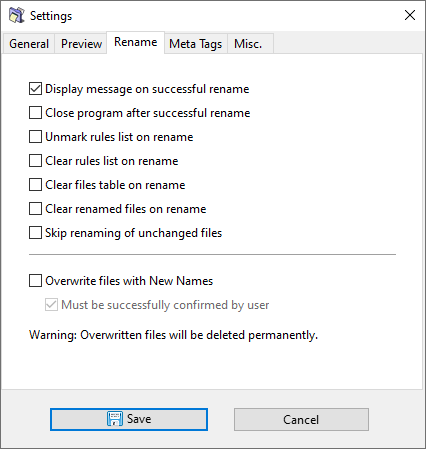
These options let you automate certain actions that follow a rename operation, or keep them manual if you prefer full control each time.
| Option | Description |
|---|---|
| Display message on successful rename | When disabled, no confirmation message is shown after a successful rename. This setting does not affect error messages. |
| Close program after successful rename | Close ReNamer automatically after a successful rename. Useful if you rename and then immediately move on to other tasks. If any errors occur, ReNamer stays open. |
| Unmark rules list on rename | Unmark all rules after a rename operation. This acts as a safety check, requiring you to explicitly re-enable rules before the next rename. |
| Clear rules list on rename | Clear the Rules pane automatically after renaming. Useful when you use a different set of rules for each renaming session. |
| Clear files table on rename | Clear all files from the table after renaming, including any files that were not renamed in the last operation. Disable this option if you plan to apply additional rules to the same set of files across multiple separate rename operations. Note: Enabling this option makes Undo unavailable. |
| Clear renamed files on rename | Remove only the files that were successfully renamed, leaving any unaffected files in the table so you can apply a new set of rules to them. Note that files are considered renamed even if the active rules did not produce a name change (for example, when inserting text at a position beyond the length of a short filename). Note: Enabling this option makes Undo unavailable. |
| Skip renaming of unchanged files | By default, all marked files are renamed even when the new name matches the original, to maintain consistent behaviour with other options that act on renamed files. Enable this option to skip files whose name would not change. |
| Overwrite files with new names | When a naming conflict arises, allows the renamed file to silently overwrite the existing file with the same name. The conflict may involve a file that exists in the same folder but is not loaded in ReNamer. When multiple files rename to the same target name, they overwrite each other in sequence, and only the last one survives. Warning: Overwritten files are permanently deleted and cannot be recovered. |
| Must be successfully confirmed by user | Applies only when Overwrite files with new names is enabled. When enabled, a confirmation dialog appears for each file that would be overwritten, and the overwrite proceeds only if confirmed. When disabled, conflicting files are overwritten silently without prompting. Warning: Overwritten files are permanently deleted and cannot be recovered. |
Meta tags settings
These settings apply to meta tag extraction.
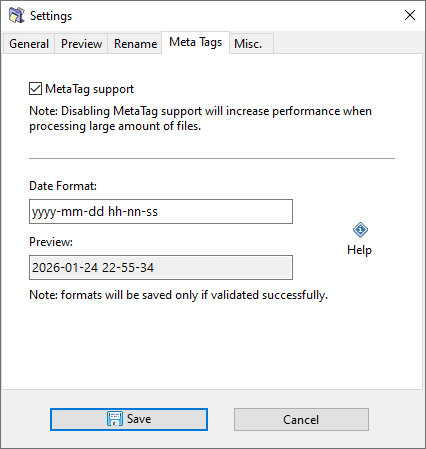
| Option | Description |
|---|---|
| Meta tag support | Enable the processing of meta tags when they are encountered. Meta tag extraction can require significant system resources. Disabling this option causes meta tags to be left in place unprocessed, which avoids that overhead entirely. |
| Date format | Specify the format used when displaying date and time meta tags. See Date and Time format for available formatting options. |
| Preview | Test the specified date and time format using the current time. |
Miscellaneous settings
This tab contains settings that do not belong to any other category.
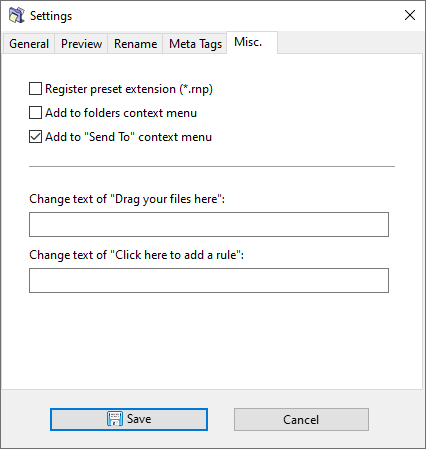
| Option | Description |
|---|---|
| Register preset extension (*.rnp) | Associate the .rnp file extension with ReNamer. |
| Add to folders context menu | Add a ReNamer entry to the context menu for folders in Windows Explorer. |
| Add to "Send To" context menu | Add a ReNamer entry to the Send To context menu in Windows Explorer. |
| Change text of "Drag your files here" | Customise the placeholder label displayed in the files table when it is empty. |
| Change text of "Click here to add a rule" | Customise the placeholder label displayed in the rules table when it is empty. |